
45 Days of Truth Series • Special Report
The Record Doesn’t Lie: What Dallas County Court Documents Reveal About Everett Jackson
He couldn’t win in DeSoto. He couldn’t stay in the Texas House race. He can’t beat Freddy Haynes in November. But Dallas County case MA1729837 reveals a pattern of conduct that TX-30 voters deserve to know about — in full, and on the record.
📋 Source note: All information in this article is drawn directly from publicly available Dallas County court records, accessible at dallascounty.org. Case ID: MA1729837. Readers are encouraged to verify the records independently.
Day 3 · Poor Character & Incompetency
Everett Jackson wants TX-30 voters to trust him with a seat in the United States Congress. He’s asking for your vote, your confidence, and your voice in Washington. Before you give him any of those things, you deserve to know what the public record actually says about him — not what he tells you, not what his campaign puts in a mailer, but what is documented in official Dallas County court files.
What follows is not spin. It is not a smear. Every claim in this article is sourced to official public records. We’re going to walk through them clearly, completely, and without embellishment — because the facts are damaging enough on their own.
The Assault Charge: Dallas County Case MA1729837
On December 27, 2017, Everett Jackson was arrested in Dallas County on a charge of assault — family violence. This is not allegation or rumor. It is documented in official Dallas County Felony and Misdemeanor Courts Case Information, publicly available on the county’s official website at dallascounty.org.
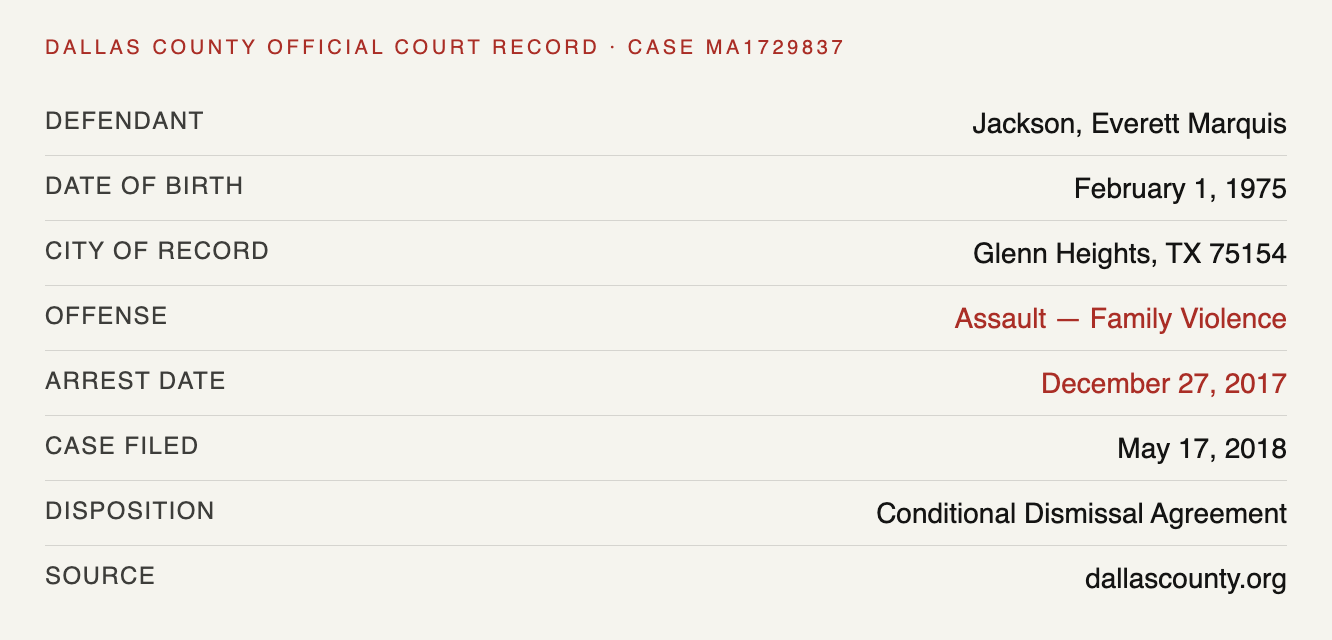
The case was ultimately disposed of through what the records describe as a “Defendant Completed Conditional Dismissal Agreement.” In plain language: the charge was dismissed after Jackson completed a set of court-imposed conditions — a standard resolution in family violence cases that typically involves counseling, a behavioral program, or other court-supervised requirements.
The charge was not expunged from public view. It was not sealed. It is sitting right there on the Dallas County public records portal — accessible to anyone with an internet connection and a reason to look. And TX-30 voters have every reason to look.
“A dismissal is not an acquittal. The charge was filed. The arrest was made. The court imposed conditions. And Everett Jackson never told voters any of it.”
Why the Dismissal Doesn’t End the Conversation
Some will argue that because the charge was dismissed, it shouldn’t be held against him. That argument deserves a direct response.
A conditional dismissal is not an exoneration. It is not the court saying “this didn’t happen” or “this man is innocent.” It is the court saying: we will close this case if the defendant completes specific required conditions. The arrest happened. The charge was filed. The court deemed intervention necessary. That is a matter of documented public record.
More importantly — and this is the part that should concern every TX-30 voter — Everett Jackson has never disclosed this to the public. He has campaigned for city council, for state legislature, and now for Congress, presenting himself as a community leader and a man of integrity. At no point has he stood before voters and said: here is my full record, including this arrest, including this charge, including the conditions I was required to complete.
That’s not just an omission. In a man seeking public trust, it is disqualifying.
This Is Not an Isolated Incident — It’s a Pattern
The assault charge does not exist in isolation. It is one entry in a longer documented record that TX-30 voters are only now beginning to see in full.
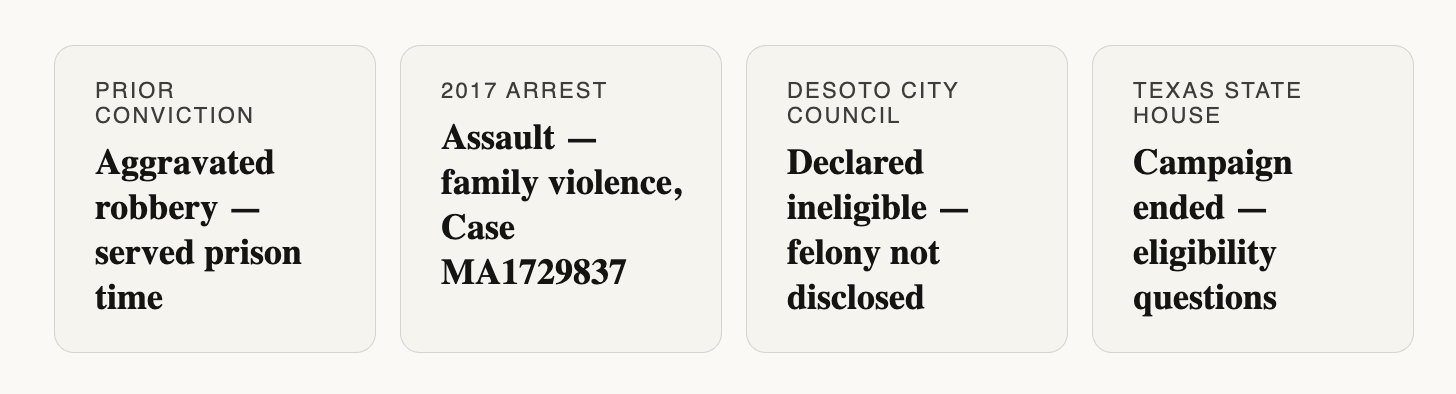
Let’s put the full picture together. Everett Jackson has a prior felony conviction for aggravated robbery — a violent crime. He was later arrested for assault family violence in 2017. He ran for DeSoto City Council without disclosing that felony conviction to voters — and when the courts determined he was ineligible to hold office, the votes of his supporters were invalidated. He then attempted a run for the Texas State House, which ended before it began when eligibility questions resurfaced. And now he is running for United States Congress — the only level of office a convicted felon can pursue under current federal law.
At every stage of this history, there has been a consistent pattern: enter a race, minimize or conceal the record, and press forward. TX-30 is not the first stop on this tour. It is just the latest one — and the only one he hasn’t been disqualified from yet.
“Voters in DeSoto had their ballots thrown out because Jackson didn’t disclose his record. TX-30 voters now have the chance to make an informed decision — if they have the information. That’s what this is.”
What This Means for TX-30
Texas’s 30th Congressional District is a community of working families, people of faith, and residents who hold personal character to a high standard. When they send someone to Washington, they are extending trust — the deepest kind of civic trust one person can extend to another. They are saying: go there and speak for us. Make decisions on our behalf. Represent who we are.
The question is not whether Everett Jackson has the right to run for office. Under federal law, he does. The question is whether he has earned the trust that seat requires. Whether the record he has spent years concealing from voters is the record of a man ready to carry the weight of that responsibility.
Based on the documented public record — the felony conviction, the family violence arrest, the pattern of entering races without disclosing disqualifying history — the answer is no. Not even close.
The Alternative Is Clear
TX-30 Republicans do not have to settle. They are not choosing between a flawed candidate and an empty seat. They have a real option — a candidate whose record is an asset, not a liability. A man whose background is built on building things, not concealing things.
Sholdon Daniels is a law firm owner, a devoted husband, an intentional father, and a man who was already building a literacy program for this district before he ever asked for a vote. His personal record and his professional record tell the same story. There is no hidden case file. There is no disqualifying history. There is no pattern of concealment.
The contrast between these two men is not subtle. And TX-30 voters — armed with the full picture — are more than capable of seeing it clearly.
The record doesn’t lie. And now you have it.
🔍
Verify it yourself: Dallas County court records are publicly accessible at dallascounty.org. Search defendant name: Jackson, Everett Marquis. Case ID: MA1729837.