
45 Days of Truth Series • Special Report
Three Races. Two Exits. One Question TX-30 Donors Deserve Answered: Where Did the Money Go?
Everett Jackson has launched — and abandoned — campaigns for DeSoto City Council, the Texas State House, and now Congress. Each time, he solicited support from donors and believers while disqualifying history went undisclosed. TX-30 voters deserve to ask a hard question: is this a campaign, or a cycle?
📋 Editorial note: This article raises documented facts and questions of legitimate public concern about a candidate seeking federal office. Readers are encouraged to review publicly available campaign finance filings and court records independently.
There is an old and simple rule in politics: if you want to understand a candidate, follow the pattern. Not the press release. Not the speech. The pattern — what they do, repeatedly, when they think the stakes are low and attention is elsewhere.
Everett Jackson’s pattern is now three races long. And it raises questions that every donor, every supporter, and every TX-30 voter deserves to sit with before casting a ballot in this primary.
The Pattern, Race by Race
The Question Nobody Is Asking — But Should Be
Here is what makes this pattern worth examining beyond the obvious eligibility failures: running a political campaign costs money. It also raises money. Candidates collect donations from supporters who believe in their viability, their vision, and their ability to win. Those donors are making an investment — financial and emotional — based on the representation that the candidate is a real contender.
When a candidate enters a race knowing — or having strong reason to know — that disqualifying history exists and has not been resolved, the donors writing checks deserve to understand what they’re funding. In the DeSoto race, that information was withheld until the courts intervened. In the Texas House race, the campaign ended before donors received clarity.
“Every political campaign that ends in disqualification or sudden withdrawal leaves donors with an unanswered question: where did my money go, and what was it actually for?”
We are not asserting that Everett Jackson has committed any financial crime. That would require evidence we do not have and are not claiming to possess. What we are asserting — based entirely on the documented public record — is that a pattern of entering races with undisclosed disqualifying history, soliciting community support, and then exiting when that history catches up is a pattern that warrants scrutiny. Campaign finance records are public. Donors who supported previous Jackson campaigns are entitled to review them.
TX-30 donors considering contributing to his current campaign are entitled to ask: is this different? Why? What has changed? And if he falls short in this primary — or is somehow found ineligible at a later stage — what happens to the money raised?
The Clout Question
There is another dimension to this worth naming directly. Political candidacy — even unsuccessful political candidacy — confers something. It confers a title: “candidate.” It confers visibility. It confers the ability to say, in community settings, in business settings, in personal settings: I am running for office. I am a public figure. I matter.
For someone without a clearly established professional profile or verifiable business track record — and Jackson’s claimed apparel business has not been independently substantiated in any public reporting we are aware of — the status of “congressional candidate” can fill a significant gap. It provides standing. It provides a reason for people to return phone calls, attend meetings, and take you seriously at the table.
We are not saying this is what drives Everett Jackson. We are saying the pattern — three races, three exits, no disclosed income, no verifiable professional anchor — is consistent with that reading. And TX-30 voters are smart enough to evaluate it for themselves.
“Running for office to gain clout rather than to win is not a new political strategy. But it is a dishonest one — and it is the people who donate and believe who pay the price.”
The Man Running to Actually Win
The contrast with Sholdon Daniels could not be more complete — and it starts with the most basic thing: Sholdon Daniels is running to win. Not to build a profile. Not to collect a title. Not to fill a gap in a resume. To win — and then to govern.
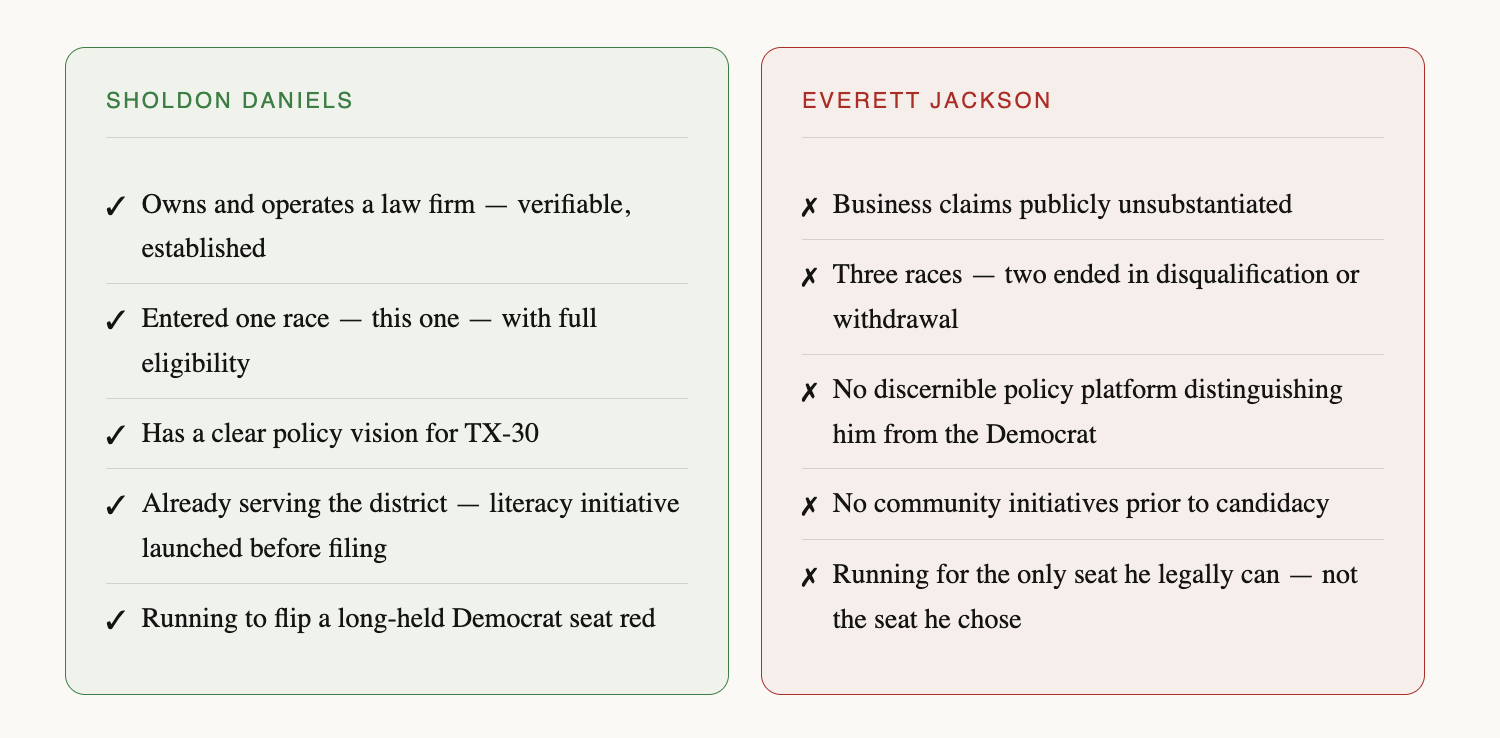
Sholdon Daniels
Everett Jackson
TX-30’s 30th Congressional District has been held by Democrats for decades. Flipping it red is not a symbolic gesture — it is a real, winnable objective for the right candidate. Sholdon Daniels is that candidate. He entered this race with a strategy, a platform, and a professional and personal record that can withstand scrutiny from any direction. He is not here to build a brand. He is here to build a majority.
That is what a serious candidacy looks like. And the contrast with what TX-30 has seen from Everett Jackson — across three races, three exits, and a trail of unanswered questions — could not be sharper.
TX-30 Republicans have a rare opportunity this primary: the chance to send a candidate to November who can actually win the seat, backed by a record that holds up, funded by donors whose investment is going somewhere real.
The pattern is clear. The choice is clear. And the campaign finance records — for anyone who wants to look — are public.